
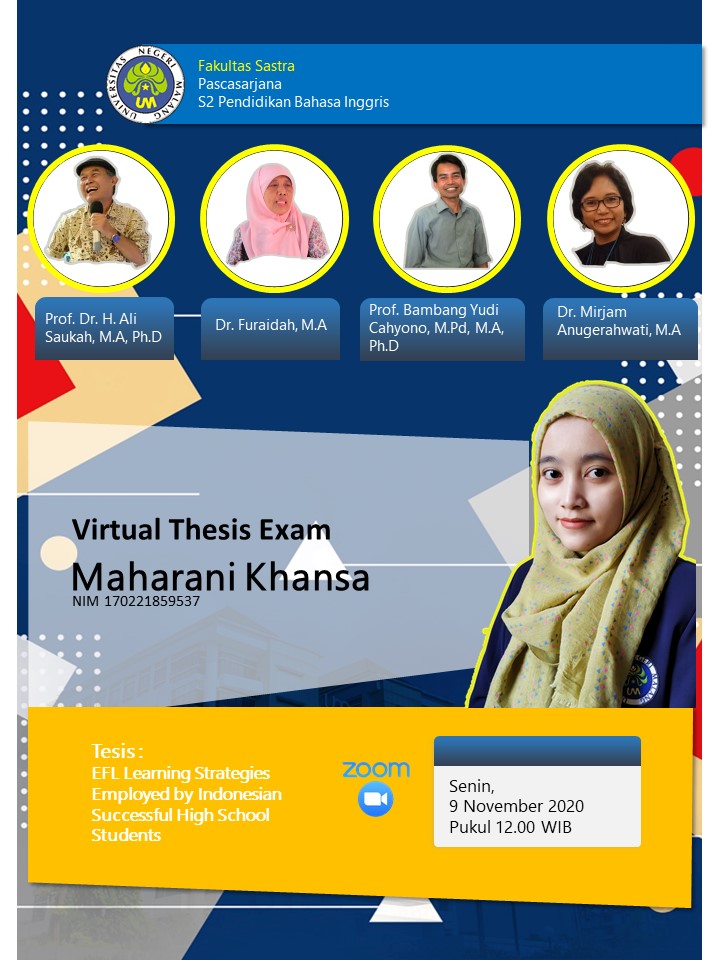
Ujian Tesis S2 Pendidikan Bahasa Inggris a.n. Bagia Tjahjadi


UM ARABIC LITERATURE DEPARTMENT INCREASES THE COMPETENCY OF MI MOJOKERTO TEACHERS TO IMPLEMENT MADRASAH CURRICULUM IN 2019
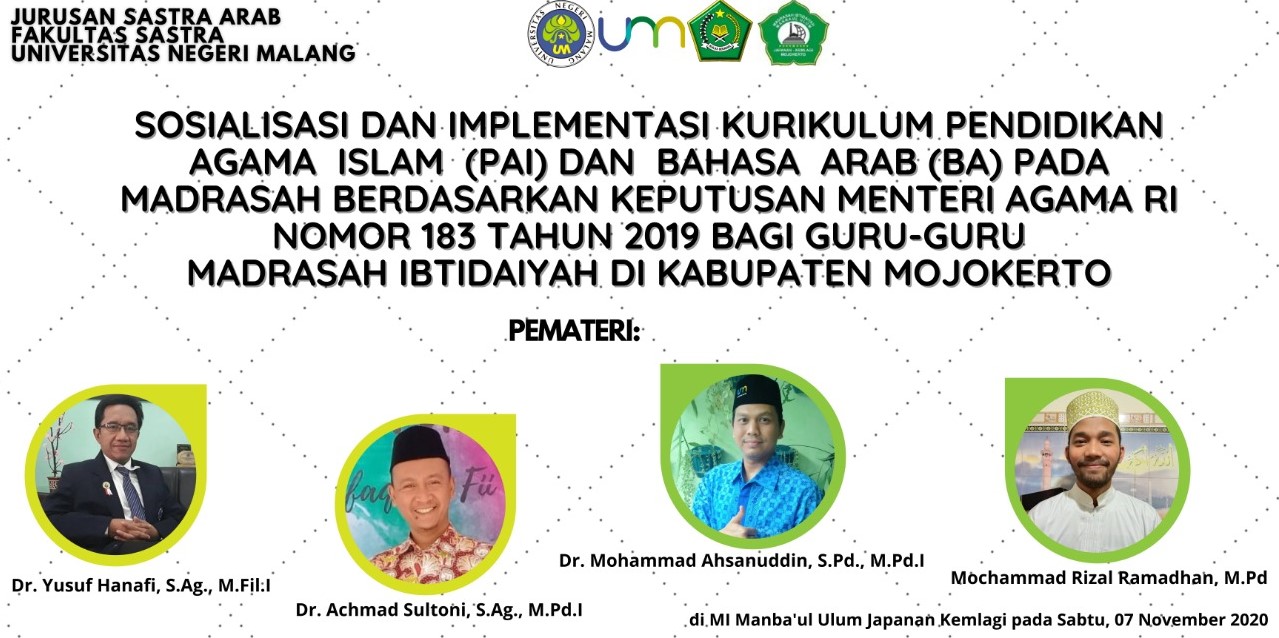
State University of Malang (UM) through the implementation team of community service (abdimas) Arabic Literature Department (JSA) Faculty of Letters (FS) carried out an activity themed "Socialization and Implementation of Islamic Education Curriculum (PAI) and Arabic Language (BA) in Madrasahs Based on the Decree of the Minister of Religion (KMA) No. 183 of 2019 for Madrasah Ibtidaiyah (MI) Teachers in Kab. Mojokerto". This activity was held on Saturday, November 7, 2020 at MI Manba'ul Ulum Japanan Kemlagi Mojokerto. This activity is carried out offline (offline) for the sake of effectiveness and optimization of activity output, after obtaining permission from the Office of the Ministry of Religion of Mojokerto Regency, by strictly implementing the COVID-19 prevention protocol.
This activity involved the head of the madrasa, teachers of Islamic Studies and Islamic Studies Arabic from three sub-districts, namely: Kemlagi, Gedeg and Jetis. A total of 14 MI from the three sub-districts were invited, with a total of 45 participants. This number limitation is carried out with the consideration of preventing the spread of COVID-19.
Head of the abdimas implementation team, Dr. Yusuf Hanafi, M.Fil.I in his speech said that through socialization and implementation activities, it is hoped that MI teachers can understand and apply the curriculum in learning practices so that later madrasah graduates have life skills in the XXI century, and are able to face the challenges of the Industrial Revolution 4.0.
Meanwhile, the Office of the Ministry of Religion of Mojokerto Regency (represented by Mr. Machfudz Fauzi, M.Pd.I) expressed his appreciation for this activity. According to him, during this pandemic, not many madrassas received direct socialization of the PAI curriculum and Arabic language. He also thanked the JSA FS UM community service team for carrying out the socialization and hoped that activities like this would be followed up with other programs so that teachers could apply what was gained from this activity.
Dr. Yusuf Hanafi, M.Fil.I delivered material entitled Arabic Language Curriculum based on KMA no. 183 of 2019: socialization and implementation. He explained that the latest Arabic language curriculum has been refined from all aspects, including KI and KD. This is also supported by the provision of textbooks as a form of the latest Arabic language curriculum which can be downloaded for free on the Ministry of Religion website. Regarding learning methods, teachers should switch to learning that is focused on students (student centered).
As for the delivery of the second material by Dr. Achmad Sultoni, M.Pd.I with the theme of the Islamic Religious Education Curriculum based on KMA no. 183 of 2019 states that teachers should apply Islamic Education learning which is oriented towards the formation of four basic 21st century skills, namely critical thinking, collaboration, creativity and communication. In addition, learning should be linked to the conditions of the community in which students live.
In delivering the last material, Dr. Mohammad Ahsanuddin, M.Pd. explain the use of technology in learning Arabic and Islamic Education. He said that in the current conditions of the Covid-19 pandemic, it is necessary to use digital learning technology so that learning is carried out interesting and meaningful, and so that students can feel the importance of learning even though it is done online. This training activity received positive appreciation from the participants. A total of 97% stated that this training was very useful and hoped that the training program would be continued. Hopefully this training activity can provide optimal benefits. So that teachers understand the changes that exist and can carry out their duties as educators professionally and responsibly.



 English
  Indonesian