by FSADMIN | Apr 10, 2018 | News
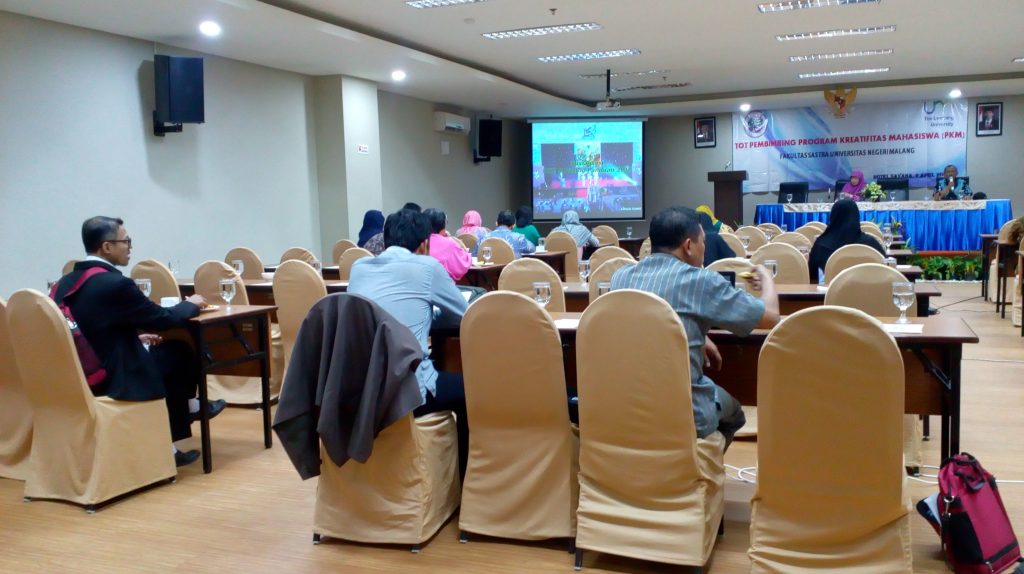
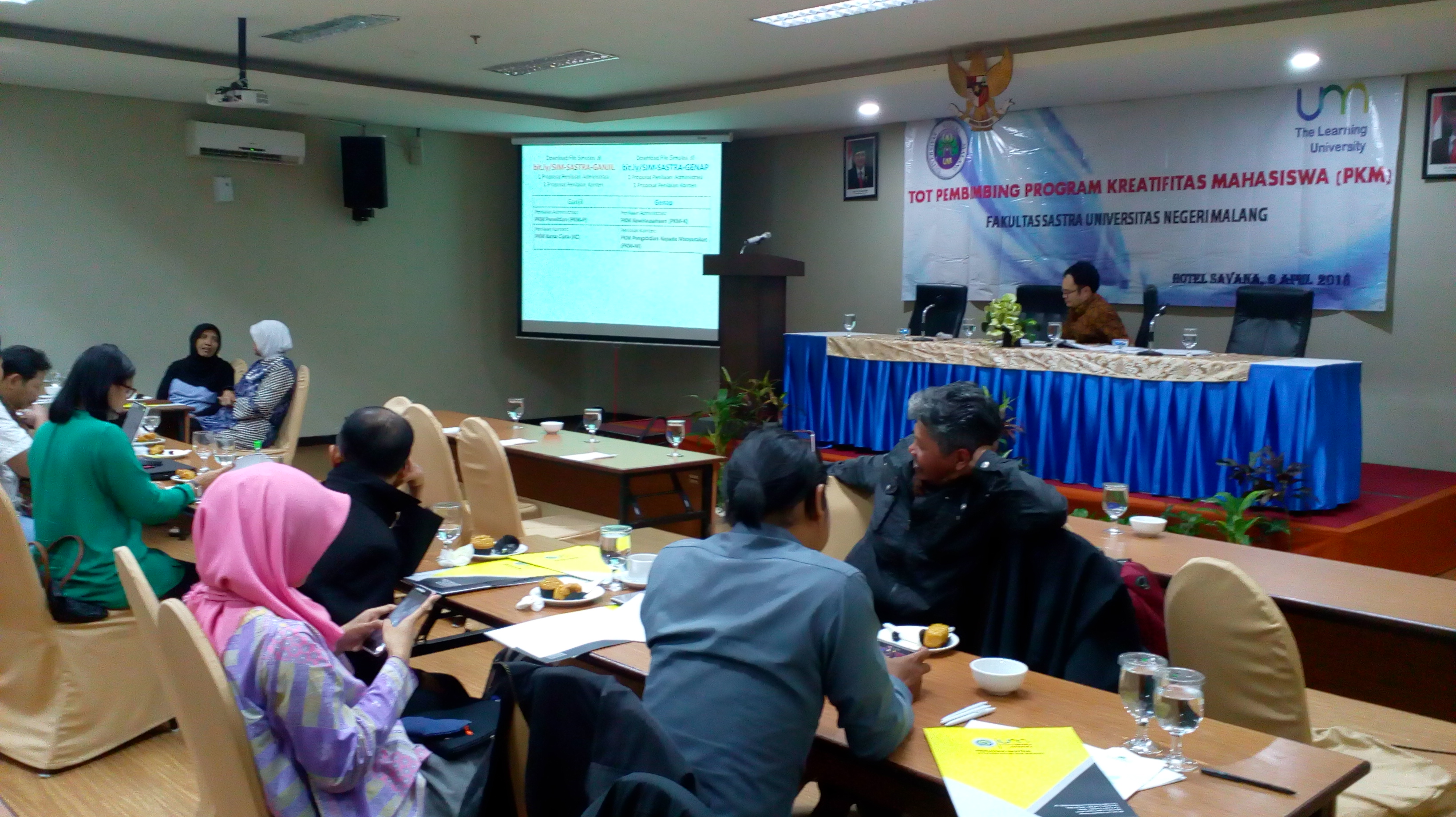
Attended by 50 participants consisting of faculty and department leaders as well as supervisors from five departments, the implementation of this TOT starts from 14.00 to 22.00 at the Pinus Hall Hotel Savana, Malang City. The TOT which is carried out is a routine activity held annually by the Faculty of Letters in order to monitor PKM supervisors so that they can improve their abilities and have a positive impact on the image of the institution and increase the competitiveness of graduates. Opened by the Dean of the FS, prospective mentors are expected to improve the quality and quantity of the PKM proposals that are financed so that the target of 46 proposals that pass can be fulfilled even more.
An interesting thing was conveyed by Ahmad Fahmi, ST, MT as a resource person and Expert Staff for WR 3 for Student and Alumni Affairs. PKM proposals have an impact on the increase in financed proposals, on the other hand, if there is no such obligation, many students make careless proposals, as evidenced by the 2,477 proposals submitted in 2016, only 28.5% which passed or 707 proposals ”. The large number of waste proposals that only obey the 2016 guidelines prompted the Higher Education to conduct an evaluation by setting quota restrictions and MUs to get a quota of 700 proposals. The quota is based on the percentage of proposals received and the Faculty of Letters gets a quota of 46 proposals.
The administrative assessment of the proposal is carried out in each unit / institution to reduce the burden on reviewers. Administrative assessment includes the writing systematics, benefits, potentials, outputs, and creativity of the PKM proposal maker. Writing systematics includes paper size, font, spacing, margins, format, and university logo. Failure to adhere to established guidelines for writing systematics results in a proposal being dropped before reading. Benefits, potential, luraan, and creativity or included in the proposal content refers to original ideas and novelty. Using the latest goals, providing great benefits to society, and having economic and sustainability value are added values that make proposals attractive and have the potential to be financed.
Several questions regarding the mechanism for the assessment and implementation of the PKM submitted by the TOT participants included Drs. Pidekso Adi, M.Pd are (1) the provisions are required and students do not make PKM proposals, (2) if there is a good proposal but do not have the chance to submit this year, can it be proposed the following year, and (3) agreement on the percentage of proposals using qualitative and quantitative approaches. Whether or not students are required to make proposals depends on the policies of each faculty, then regarding proposals related to time, the resource person said that the long time for submitting proposals from April to September 2018 was more than enough to do planning to make a finished proposal so that there should be no problems, and there is no percentage of proposals with qualitative or quantitative approaches.
In the second TOT session, participants were invited to simulate to become PKM assessors divided into 10 groups who were given the task of reviewing proposals from the administrative and content sides. The assessment of the administrative side of the proposal is clear because it is only checked and if it is not suitable or does not meet the requirements, it will fail and cannot continue to the next session. The assessment of the content session begins with the suitability of the theme, content, and output to the type of PKM then the originality and quality of the proposal. Assessment of content sessions must be carried out in a detailed and coherent manner so that the level of validity of the PKM proposal assessment can be accounted for.
This TOT activity was closed by presenting an evaluation of the activities carried out by the committee by distributing satisfaction questionnaires to participants which included an assessment of satisfaction with implementation, resource persons, and services. The overall score of the implementation was 80% the participants said it was good and 20% was satisfactory. The assessment of the informants was that 4% stated that it was sufficient, 64% was good, and 32% was satisfactory. 8% was sufficient, 64% was good, and 28% stated that it was satisfactory to the committee's service and the place where the TOT was held. From this assessment, the average TOT participant said it was good for this event, hopefully the next event can be improved again.
by FSADMIN | Mar 14, 2018 | News, Cooperation
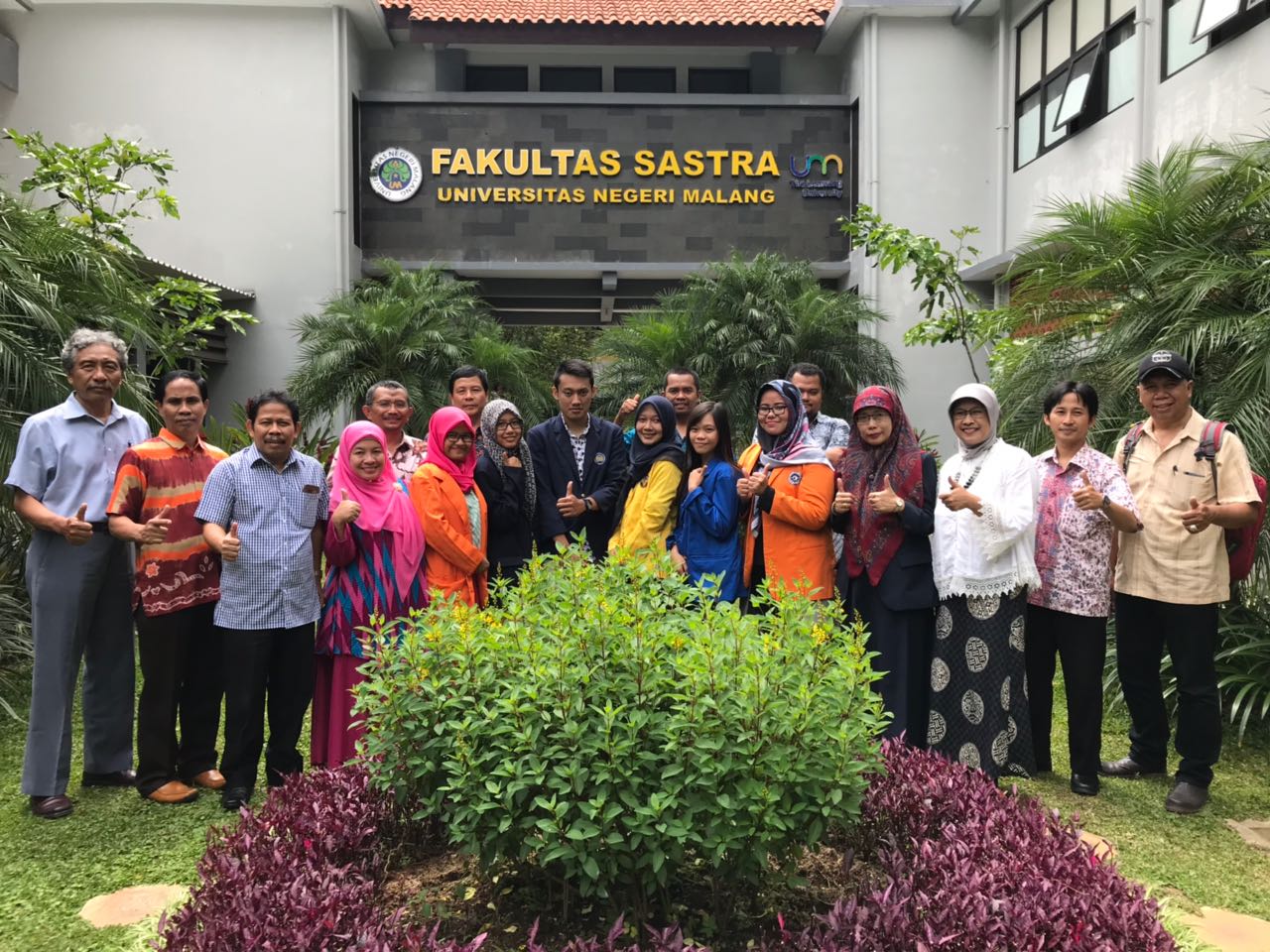
The Faculty of Letters this year held a Credit Transfer program for 11 LPTKs throughout Indonesia or more commonly known as students "Gem". This program aims to increase cooperation between universities, which currently has 6 universities, namely Malang State University, Makassar State University, Semarang State University, Surabaya State University, Indonesia Education University, and Manado State University. Yesterday, on March 13 2018, the Faculty of Letters received 6 students from various universities to enter the Department in the Faculty of Letters. Nur Hikmah and Miftakhul Khairah from Makassar State University, Nadia Azizah from Semarang State University, Yoga Rifqi Azizan from Surabaya State University, Nuriska Garnitasari from the Indonesian Education University, as well Fergie Mamangkey from Manado State University. Greeted by the Dean of the Faculty of Letters Prof. Utami Widiati, MA, Ph.D along with their staff, these students were very happy and excited for the future to gain knowledge and gain many new experiences at the Faculty of Letters, State University of Malang. It is hoped that in the future this kind of cooperation can be sustainable and further enhance cooperation in the academic field for the advancement of the world of education in Indonesia.

by FSADMIN | Mar 9, 2018 | News
Opened by the Deputy Dean III for Student and Alumni Affairs, the ORMAWA FS Integrated Working Meeting was attended by Heads of Departments, Secretaries of Departments, and Supervisors as well as Heads and Secretaries of BEMFA and HMJ. The Dean's direction delivered by Vice Dean III highlighted the loyalty of student activities, especially PKM in 2017, which could only pass five proposals from the target of 20 financed proposals so that a special program was needed to make PKM this year a success.
Furthermore, Dr. H. Kholisin, M.Hum, provides direction on what ORMAWA 2018 needs to program, including several strategic programs, namely: student seminars in the frame of a national seminar attended by students as presenters, not only as a committee, there needs to be a large-scale faculty ORMAWA program and prestigious, there needs to be a program that touches the wider community during long holidays, and the most important thing is that ORMAWA activities must be balanced between academics, talents, organizational, social, religious, and so on in accordance with the nine guidelines for the university's ORMAWA fields.
Direction was also given by the Head of Administration, Khoiriyah, SH, especially in relation to the flow of requests for funds and SPJ for ORMAWA activities, in which every proof of expenditure must be verified by the chairman of the ORMAWA / HMJ. This is done for accountability and monitoring of ORMAWA budget absorption realization.
In designing the program, the chairperson and secretary of ORMAWA focused on nine ORMAWA areas that the university had launched, namely (1) Extracurricular; (2) Reasoning and Science; (3) Organizational Management; (4) Entrepreneurship; (5) Character Development; (6) Social Society; (7) Talents and Interests; (8) Welfare; and (9) Alumni Empowerment, in which one sector has a balanced portion of activities and supports each other so that the achievement of the faculty vision and mission in the field of student affairs and alumni can be achieved.
This two-day working meeting resulted in the 2018 program design and several agreements, namely (1) the need to form a consortium of sponsor seekers and assistance in making proposals to be eligible for sponsorship, (2) the need for control and evaluation of institutions (faculties) by providing an assessment of the implementation of activities, and (3) MPA activities can be packaged in the form of research and community service. The 2018 program design is well scheduled by taking into account the needs and calculating the timing of activities between ORMAWA in line with the direction of the faculty leaders and supervisors. Hopefully it can run smoothly and can increase creativity and togetherness of the ORMAWA Faculty of Letters, State University of Malang more advanced.
by FSADMIN | Feb 14, 2018 | News, Announcement, Achievement, Student Achievements
ANNOUNCEMENT
No: 14.2.5 / UN32.2.3 / KM / 2018
About
Nominee for Student Achievement, Faculty of Letters, State University of Malang in 2018
Based on the results of the Judges' Assessment for Student Achievement at the Faculty of Letters, State University of Malang in 2018, 3 nominees were decided as follows:
| Nominator |
Name |
NIM |
Department |
|
I |
Elmiatun Nafi'ah |
150222605108 |
English literature |
| II |
Muhammad Abdul Hafidz |
160231603232 |
Arabic literature |
| III
|
Akbar Rahmada Maulana |
150222602788 |
English literature |
Nominees are then sent to the University to participate in the selection of Outstanding Students at the University level.
Thus, this announcement is made to be used as intended.
Malang, 14 February 2018
an Dean Vice Dean III,
TTD
Dr. H. Kholisin, M.Hum
NIP 19651 209 199002 1 001
by FSADMIN | Dec 28, 2017 | News
by FSADMIN | Dec 28, 2017 | News
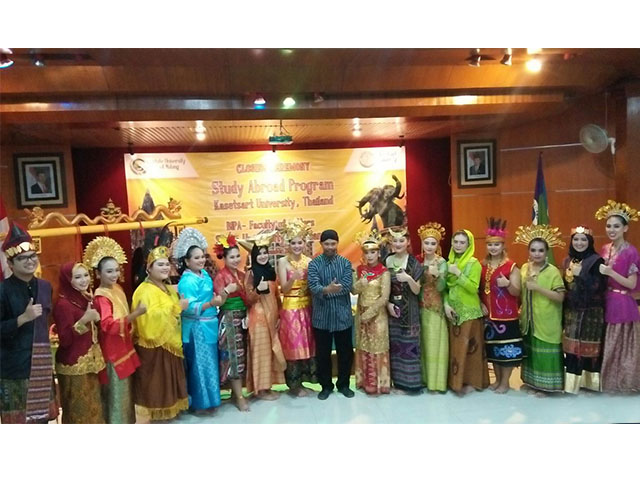
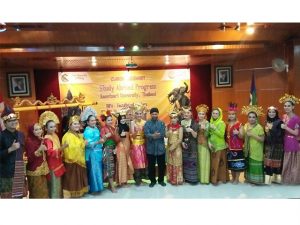
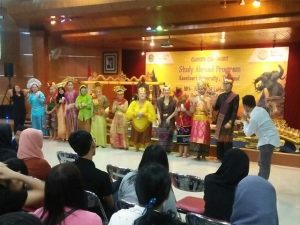
Malang – Fakultas Sastra Universitas Negeri Malang resmi menutup Study Abroad Program 2017 yang sudah berjalan selama tiga minggu, sejak tanggal 10 Desember 2017. Program ini merupakan salah satu kegiatan yang diorganisir BIPA (Bahasa Indonesia Untuk Penutur Asing) Universitas Negeri Malang.
Tujuan utama dari program ini adalah sebagai ajang pengenalan bahasa dan budaya Indonesia,” tutur Huda Nur Syairofi, salah satu pengajar BIPA di aula Fakultas Sastra, Kamis (28/12/2017). Program ini diikuti oleh 12 orang yang berasal dari Kasetsart university, Thailand. Peserta belajar secara intens tentang bahasa dan budaya Indonesia. Program ini dilaksanakan setiap harinya mulai jam 8 pagi sampai jam 1 sore di balai bahasa Universitas Negeri Malang. Selama program berlangsung, masing-masing peserta didampingi oleh satu orang tutor yang merupakan mahasiswa dari beberapa fakultas di Universitas Negeri Malang.
Selain pembelajaran yang dilaksanakan di kampus, peserta juga mengikuti Trip ke Gunung Bromo, Batu dan Blitar. Setiap harinya para peserta juga belajar untuk memainkan alat musik Gamelan. Diharapkan melalui rangkaian kegiatan ini, pembelajaran dapat berlangsung lebih menarik bagi peserta.
(*)



 English
  Indonesian